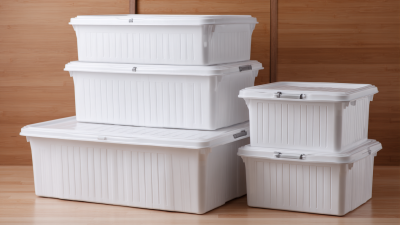
Honestly, when global buyers pick a Plastic Storage Container, a low unit price is only one piece of the puzzle. What really matters is consistent quality, a design that actually works in the real world, and a supply chain you can count on. A container can look tough in a sample and then crack on a cold-weather delivery. Another one might save warehouse space but make stacking a headache. Those little things add up—labor, returns, customer trust. And let's face it, no container is perfect.
So this guide looks at the 2026 best Plastic Storage Container types for different commercial needs. We'll compare polypropylene, polyethylene, recycled plastic, collapsible, nesting, and airtight designs. Each has its own strengths. For food storage, you need the right materials and clean manufacturing controls. Industrial buyers might care more about impact resistance, load capacity, and how it holds up to repeated handling. Retailers, on the other hand, may want transparent walls, smooth finishes, and packaging that looks good on the shelf. In real purchasing decisions, sample testing, lid-fit checks, drop tests, and temperature exposure should all be part of the process. Small trials can catch problems early.
Reliable sourcing also comes down to supplier experience. Buyers should look at production records, inspection procedures, material declarations, and export performance. Certifications can help build trust, but you still need to verify them for the specific product and market. A factory audit might uncover weak storage practices or inconsistent molding conditions. That matters. Freight planning is just as important. Nested containers can cut volume, while rigid models may need stronger cartons. Buyers should also confirm dimensions, tolerances, labeling, and replacement-part availability. Specs can change. People make mistakes. So this article offers a practical framework for comparing Plastic Storage Container options—with clearer expectations, measured evidence, and room to rethink things carefully.
Plastic storage containers are rigid or semi-rigid vessels designed to hold, protect, and organize goods. A Plastic Container Box may use polypropylene, high-density polyethylene, or polyethylene terephthalate. Common uses include household storage, warehouse handling, textile protection, and component transport. Some designs stack securely, while others nest when empty. Small details matter. A weak hinge or uneven lid can damage an otherwise useful container.
Their global market role extends beyond simple organization. Reusable containers can reduce replacement purchases, protect products during long-distance shipping, and improve warehouse space utilization. The OECD’s Global Plastics Outlook reported 353 million tonnes of plastic waste in 2019, with only 9% recycled. This is not a container-specific figure. Still, it exposes the wider responsibility facing buyers and manufacturers. Material selection, service life, repairability, and end-of-life pathways deserve equal attention.
UNEP’s Turning off the Tap report states that plastic pollution could fall by 80% by 2040 through existing solutions, including reuse and better design. For global buyers, this supports evaluating containers by total service value, not only unit price. Buyers should check wall thickness, closure performance, load limits, temperature tolerance, and recycled-content claims. Certification records should be traceable. Claims can be imperfect. Fit still matters. In my experience, a slightly heavier box often survives repeated handling better, but added material is not automatically sustainable. Balancing durability, transport weight, cleaning needs, and local recycling access remains essential.
For global buyers, plastic storage containers should match the application, not only the price. Food warehouses often use polypropylene containers because they tolerate repeated washing and moderate heat. High-density polyethylene suits chemicals, spare parts, and outdoor storage. Clear PET containers help workers identify contents quickly, but they can scratch and reduce visibility. Small details matter.
The OECD’s Global Plastics Outlook reported 353 million tonnes of plastic waste in 2019, nearly twice the 2000 level. Packaging represented about 40% of that waste. This data supports longer-life designs, replaceable lids, and recyclable mono-material construction. A Plastic Pallet Container works well for bulk logistics, automotive components, and warehouse transfers. Reinforced corners reduce impact damage, while stackable bases protect floor space. However, oversized containers may increase empty transport costs.
UNEP’s 2023 Turning off the Tap report found that plastic pollution could be reduced by 80% by 2040 through reuse, recycling, and better product design. Buyers should therefore compare return cycles, cleaning requirements, and end-of-life options. For cold storage, flexible containers may resist cracking better than rigid alternatives. For dusty workshops, gasketed lids provide stronger protection. My earlier specifications often focused too heavily on wall thickness. That was incomplete. Handle comfort, label adhesion, drainage, and repair access can decide whether a container performs well after hundreds of uses.
For global buyers in 2026, plastic storage containers should be judged by material, not appearance alone. In practical warehouse evaluations, polypropylene often handles repeated opening, light impacts, and moderate heat better than brittle plastics. It stays relatively light, which can reduce shipping weight. A Small Plastic Container Box made from polypropylene suits screws, craft supplies, dry parts, and household sorting. Yet its lid fit matters more than product photos suggest. Dust enters through tiny gaps.
High-density polyethylene offers strong impact resistance and performs well in cooler storage areas. It suits bulk bins, outdoor utility storage, and transport handling. However, thin walls may flex under heavy stacking. Polyethylene terephthalate provides useful clarity and good stiffness for visible contents. It works better for dry goods and organized retail storage than rough industrial use. Transparency helps inspection. Scratches can appear quickly.
For warmer environments, buyers should check the tested temperature range instead of trusting “heat-resistant.” Recycled-content plastics can reduce material demand, but quality may vary between batches. Ask for migration, impact, odor, and load tests when containers hold ordinary household goods. Do not assume a thicker wall guarantees longer service. Poorly designed corners can crack first. A field mistake is focusing on the box while ignoring hinges, seals, and interior drainage. The material is only half the decision.
Size should match the product, shelf, and shipping carton. In purchasing reviews, I measure usable volume, not only the advertised capacity. A container that holds 10 liters may lose space around curved walls. Small containers suit samples, spices, and hardware. Large units reduce handling, but become heavy when full. A 5-liter format is often easier for one person to lift repeatedly. That detail matters in warehouses.
Shape affects both access and freight efficiency. Rectangular containers usually use shelf space better than round ones. However, round bodies can resist pressure more evenly and clean with fewer corners.
Closure choice depends on moisture, dust, and opening frequency. Snap lids provide quick access. Screw closures can offer stronger sealing when threads are precise. Gaskets help, but poor fitting can still cause leaks.
Test them.
Stackability needs more than a flat lid. Look for reinforced rims, stable bases, and nesting depth. Filled containers should remain aligned after movement, not slide like loose tiles. I recommend testing stacked units with realistic weight for several days. Check lid deformation, corner stress, and pallet height.
My own mistake was trusting empty-container stability. Loaded containers behaved differently.
Buyers should also confirm temperature range, wall thickness, and material documentation for the destination market. Small design checks prevent expensive re-packing later.
For global buyers in 2026, the best plastic storage container depends on safety, durability, sustainability, and compliance. A Plastic Airtight Container Box should have a secure lid, stable walls, and a gasket that remains flexible after repeated use. Inspect the closure after opening and closing it several times. Small leaks become expensive problems.
Safety begins with material evidence, not attractive packaging. For food, cosmetics, or household storage, request food-contact declarations and migration test results where applicable. Buyers should also check substance restrictions, recycled-content claims, labeling rules, and documentation for each target market. Requirements differ across countries. Do not rely on a supplier’s general statement alone. Batch records and test dates matter.
Durability can reduce replacement waste, but thicker plastic is not automatically better. Heavy containers increase transport emissions and handling costs. Look for impact resistance, temperature limits, stack strength, and UV performance. Recycled content may support sustainability, yet it can affect clarity, odor, or consistency. A recyclable container can still fail if local collection systems cannot process it. This is not a perfect formula. Procurement teams should test samples with real loads, damp storage rooms, and warehouse drops before placing large orders.
| Plastic Type | Common Resin Code | Typical Storage Applications | Typical Service Temperature* | Food-Contact Safety Profile | Durability and Chemical Resistance | Sustainability Considerations | Key Regulatory and Documentation Requirements | Important Buyer Checks |
|---|---|---|---|---|---|---|---|---|
| High-Density Polyethylene (HDPE) | 2 — HDPE | Dry food, liquid food, household chemicals, agricultural products, industrial materials, and rigid bulk containers. | Approximately −40°C to 80°C for many container designs; exact limits depend on grade, wall thickness, closure, and load. | Widely used for food contact when the specific grade, additives, colorants, and manufacturing process are approved for the intended use. | High impact resistance; very good moisture resistance; good resistance to many acids, bases, and detergents. Can stress-crack with some solvents and oxidizing chemicals. | Widely collected in many recycling systems; recyclable in principle. Lightweight design can reduce transport emissions. Recycled content may require separate food-contact evaluation. | Food-contact declarations or test reports may be required under applicable rules such as U.S. FDA food-contact provisions, EU Framework Regulation 1935/2004 and Plastics Regulation 10/2011, or equivalent national requirements. | Confirm food-contact grade, recycled-content percentage, closure compatibility, leak testing, drop testing, and chemical-compatibility data. |
| Polypropylene (PP) | 5 — PP | Reusable food containers, microwaveable storage, laboratory containers, caps, tubs, and hot-fill packaging. | Approximately 0°C to 100°C for many products; some formulations tolerate higher temperatures, but repeated heating can shorten service life. | Commonly selected for food contact because of its relatively high heat resistance; compliance remains dependent on the exact formulation and intended conditions of use. | Good fatigue resistance and hinge performance; good resistance to many acids, bases, and detergents. More vulnerable to low-temperature impact than HDPE. | Recycling availability is increasing but varies significantly by country and municipality. Reusable PP can reduce single-use consumption when correctly designed and used. | Require applicable food-contact documentation, migration testing under realistic time and temperature conditions, and confirmation that microwave or hot-fill claims are supported by testing. | Check warpage after heating, lid sealing, repeated dishwasher performance, odor retention, colorant compliance, and freezer-to-microwave transition limits. |
| Polyethylene Terephthalate (PET) | 1 — PET | Clear dry-food containers, beverage and liquid-food packaging, jars, salad boxes, and transparent retail storage. | Approximately −20°C to 60°C for many standard containers; standard PET is generally not suitable for high-heat applications unless specifically engineered and tested. | Commonly used for food and beverage contact when manufactured from an approved grade and controlled process. Avoid assuming that all PET products are suitable for hot filling. | High clarity, good stiffness, and good barrier performance against moisture and gases. Can become brittle under certain impact or temperature conditions. | Highly established recycling stream in many markets. Clear, unpigmented PET is generally more valuable for recycling than heavily colored or multilayer constructions. | Require food-contact compliance documentation, applicable migration testing, recycled-PET traceability where used, and confirmation of heat, carbonation, or retort suitability. | Check haze, acetaldehyde or odor control where relevant, closure torque, UV exposure, drop performance, and compatibility with oily or alcoholic contents. |
| Low-Density Polyethylene (LDPE) | 4 — LDPE | Flexible pouches, squeeze containers, liners, freezer bags, soft covers, and flexible secondary storage components. | Approximately −50°C to 60°C for many flexible products; exact limits depend on film structure, seal design, and contents. | Frequently used in food-contact films and flexible packaging when the formulation and adhesives, inks, and coatings meet applicable requirements. | Excellent flexibility and low-temperature performance; good moisture resistance. Lower stiffness and puncture resistance than HDPE or PP. | Recycling infrastructure is less consistent than for rigid HDPE or PET. Reusable formats and mono-material construction can improve end-of-life options. | Assess the complete structure, including inks, adhesives, coatings, and seals. Obtain food-contact declarations and migration data for the intended food type and temperature. | Check puncture resistance, seal integrity, compression strength, odor transfer, freezer performance, and whether local collection accepts flexible LDPE. |
| Polystyrene (PS) | 6 — PS | Lightweight dry-goods trays, disposable food containers, protective inserts, and low-cost short-term storage. | Approximately 0°C to 70°C for many rigid products; foamed PS has lower mechanical strength and should not be treated as a general heat-resistant material. | Some grades are approved for specific food-contact uses, but suitability depends on residual monomer control, additives, intended food, and temperature. | Good dimensional stability and low cost; relatively brittle and less resistant to impact, solvents, and elevated temperatures than HDPE or PP. | Recycling access is limited in many regions, especially for foamed formats. Lightweight construction reduces material use but may create collection challenges. | Verify applicable food-contact status, residual-substance controls, restrictions on additives, and market-specific rules concerning disposable or expanded PS products. | Check local restrictions, breakage risk, heat exposure, solvent compatibility, and whether the intended market accepts PS for the proposed application. |
| Acrylonitrile Butadiene Styrene (ABS) | Usually not assigned a single packaging resin code | Rigid industrial bins, tool organizers, reusable equipment cases, and non-food storage components. | Approximately −20°C to 80°C for many products; prolonged exposure to higher temperatures can cause deformation or property loss. | Not a default choice for direct food contact. Use only when the specific formulation and applicable regulations explicitly support the intended contact. | Very good rigidity, impact resistance, and surface finish; limited resistance to some solvents and strong oxidizing chemicals. | Recycling is more complex than for single-resin commodity packaging. Design for disassembly and clear material identification can improve recovery options. | For non-food industrial use, request material safety information and chemical-compatibility data. For food contact, obtain specific regulatory evidence rather than relying on the resin name alone. | Check impact performance, solvent exposure, UV stabilization, flame-retardant additives, and whether rubber modifiers or coatings affect recyclability. |
| Polycarbonate (PC) | 7 — Other | Reusable rigid containers, laboratory storage, protective housings, and applications requiring transparency and high impact strength. | Approximately −20°C to 120°C for many engineered products; repeated heat cycles and sterilization require product-specific validation. | Some PC formulations may be permitted for particular food-contact applications, but buyers should verify current regional requirements and the use of bisphenol-based chemistry. | Excellent impact resistance and dimensional stability; can be scratched and may be affected by some solvents, alkaline cleaners, or repeated harsh washing. | Recycling streams are less widely available than for PET, HDPE, or PP. Long service life can improve resource efficiency when the product is genuinely reusable. | Obtain a formulation-specific declaration, migration testing, sterilization validation where applicable, and confirmation of restrictions affecting bisphenols or other additives in the target market. | Check chemical exposure, dishwasher or autoclave cycles, scratch resistance, transparency retention, and market-specific food-contact restrictions. |
| Polyamide (PA / Nylon) | 7 — Other | Specialized industrial containers, technical components, high-strength closures, and applications requiring abrasion resistance. | Approximately −40°C to 100°C for many grades; moisture absorption can alter dimensions and mechanical properties. | Food-contact use is formulation-specific and requires evidence for the exact polymer, additives, processing conditions, and intended food-contact conditions. | High strength, abrasion resistance, and temperature capability; absorbs moisture and may be attacked by strong acids or some oxidizing agents. | Recycling is technically possible but collection and sorting are limited in many markets. Longer service life may offset higher material complexity in demanding uses. | Require food-contact declarations where relevant, moisture-conditioning data, migration testing, and documentation for additives, glass fibers, coatings, or multilayer structures. | Check dimensional stability, moisture uptake, seal performance, chemical compatibility, and whether reinforcement materials are suitable for the application. |
Global buyers should evaluate suppliers before comparing container shapes. Material choice affects durability, safety, freight, and recycling options. Polypropylene suits repeated household use, while HDPE performs well in rigid industrial storage. Clear containers improve visibility, but additives and colorants require closer review. PlasticsEurope’s Plastics—The Fast Facts 2024 reports 400.3 million tonnes of global plastics production in 2022. Scale demands responsible sourcing.
Ask suppliers for resin specifications, batch traceability, dimensional tolerances, and test records. Request pre-production samples, not only catalog photographs. Test lids, hinges, stacking strength, odor, and drop resistance under realistic temperatures. Samples expose weaknesses. In practical supplier reviews, inconsistent wall thickness often creates poor lid fit and higher returns. A low unit price can still be the wrong purchase. Compare total landed cost, including tooling, inspection, packaging, duties, storage, and expected defect rates.
Sustainability claims need evidence. The OECD Global Plastics Outlook states that only 9% of plastic waste was recycled globally in 2019. Buyers should verify recycled content, material identification, and local recovery compatibility. For food or cosmetic storage, obtain applicable migration documentation and independent laboratory results. For international orders, audit production capacity, worker safety controls, quality systems, and corrective-action records. ISO 9001 certification can support consistency, but it does not replace product testing. No scorecard is perfect. Recheck assumptions after pilot shipments. A container that passes factory inspection may still fail during humid ocean transport or crowded warehouse stacking.
They are rigid or semi-rigid vessels for holding, protecting, and organizing goods. Common uses include home storage, warehouse handling, textile protection, and component transport. Some stack; others nest when empty. A weak hinge can ruin a useful box.
Polypropylene suits repeated washing, light impacts, and moderate heat. High-density polyethylene handles impacts, cooler storage, and outdoor use. Clear polyethylene terephthalate helps workers inspect dry contents. Appearance alone is not enough.
Check wall thickness, closure fit, load limits, temperature tolerance, handles, labels, and drainage. Reinforced corners can reduce impact damage. Stackable bases help save floor space. Small details matter.
No. Reuse can reduce replacement purchases and protect goods during transport. However, extra material, cleaning energy, empty return trips, and poor recycling access can weaken benefits. A heavier box may last longer, but heavier is not automatically greener.
Choose durable designs with replaceable lids and repairable parts. Prefer simple material structures when local recycling systems can process them. Plan return cycles and end-of-life routes before buying. Claims can be imperfect.
Request traceable test records for impact, odor, load, and temperature performance. Confirm actual dimensions and stacking limits. Ask for sample testing with real contents. Product photos can hide lid gaps.
Flexible designs may resist cracking in cold storage. Gasketed lids help block dust in workshops. Test the container at actual temperatures and handling conditions. Do not trust “heat-resistant” alone.
Stackable containers use warehouse height efficiently. Nestable designs reduce empty-return volume. Oversized boxes may increase transport costs when empty. Measure the full return cycle, not only the loaded shipment. Fit still matters.
I once focused too much on wall thickness; that was incomplete. Handles, hinges, seals, labels, and drainage can decide long-term usability. Test samples. A thicker wall cannot fix poor design.
Plastic Storage Container solutions play an important role in household organization, food handling, industrial packaging, retail distribution, and logistics worldwide. This article explains their basic definition, common uses, and role in the global market, while comparing types such as bins, boxes, tubs, drums, trays, and specialized containers for different applications. It also reviews material choices, including their strength, flexibility, temperature resistance, clarity, and chemical compatibility.
For global buyers, selecting the right Plastic Storage Container requires careful evaluation of size, shape, closure systems, stackability, durability, and space efficiency. Safety, hygiene, sustainability, recyclability, and applicable regulatory requirements should be considered before purchase. The article also provides practical guidance for comparing suppliers, including product consistency, customization capability, quality control, certifications, production capacity, packaging, lead times, communication, and total cost. These factors help buyers make reliable, responsible, and cost-effective purchasing decisions across international markets.